The findings, published in October 2026, examine how occupational and environmental exposures early in life may be associated with increased risk of Alzheimer’s disease-related brain changes decades later.
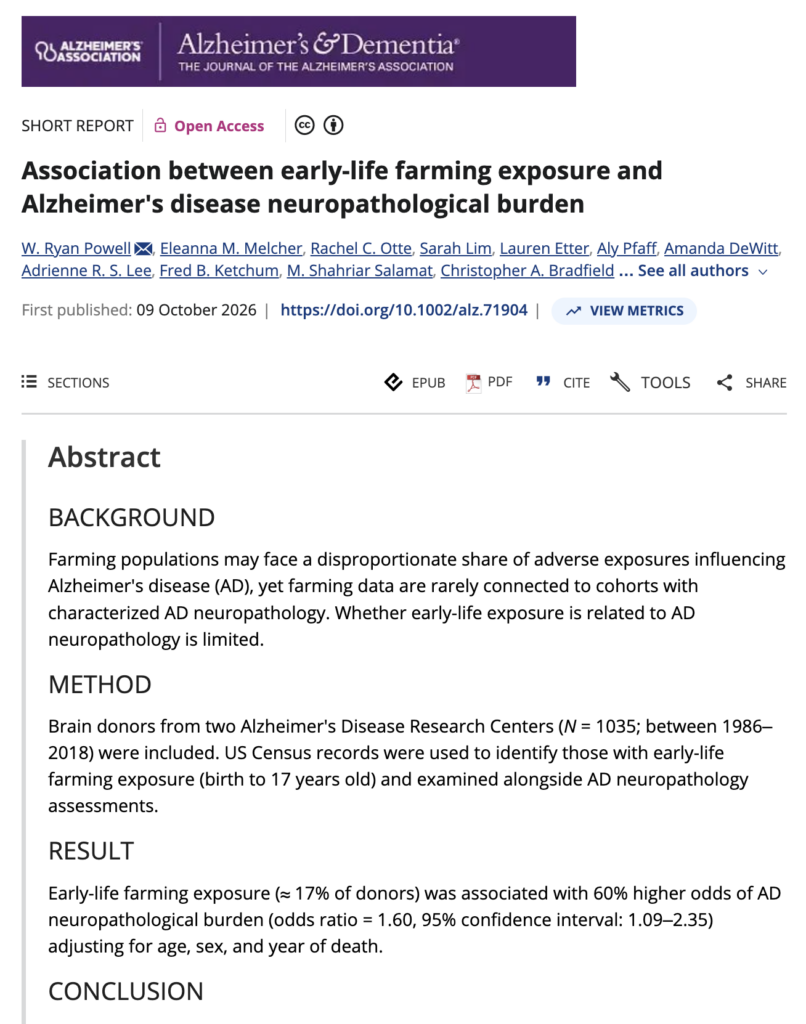
A study led by Ryan Powell, PhD identifies an association between early-life farming exposure and increased Alzheimer’s disease (AD) neuropathological burden. Published in Alzheimer’s & Dementia, the study offers new insight into the potential influence of occupational and environmental exposures across the life course.
Powell and his colleagues examined records from 1,035 brain donors across two Alzheimer’s Disease Research Centers, using historical U.S. Census records to reconstruct individuals’ residential and occupational histories between birth and age 17. Approximately 17% of donors had documented early-life farming exposure.
Structured statistical analysis revealed that individuals with early-life farming exposure had 60% higher adjusted odds of AD neuropathological burden than those without documented exposure. These findings represent an important contribution to research connecting occupational and environmental exposures with biological indicators of Alzheimer’s disease.
“Early-life farming may reflect the complex interplay of factors across the exposome, including life-course socioeconomic conditions, education, rural residence, cohort/period effects, and lifelong occupational trajectories, all of which may influence later life AD risk.”
While the specific reasons underlying this association remain unclear, the findings highlight the importance of comprehensive occupational and residential histories in investigating how multiple, overlapping exposures throughout life may influence brain health.
This work advances research on the relationship between social, environmental and occupational conditions and health, a particularly relevant area of inquiry in agricultural states like Wisconsin. Understanding how occupational and environmental exposures may shape health across the life course can help inform efforts to support the long-term health and well-being of current and future generations and the people and communities that sustain us.

Ryan Powell is an assistant professor in the Department of Medicine: Geriatrics and Gerontology and associate director of social science with the Center for Health Disparities Research (CHDR).
This project was supported by National Institute on Aging Awards R21AG079277, R01AG070883, P30AG062715, R01AG079303, and P30AG066530.